A Brazilian Jiu Jitsu blog about everything.


Tuesday, July 23, 2013

Brazilian Jiu Jitsu is Simultaneously Therapy and a Problem I NeedTherapy For


That says it right there.  

It's such a beautiful combination of a problem solver and a problem creator.  

I almost hate to tell new guys how much it will worm its way into your soul and consciousness.  

The black belt comes with its own set of issues and problems.  Its own ever deepening web of complexity, sorrow and just occasionally enough....freedom.

I mean, really, you could camp out at any belt i suppose, and decide not to progress, and just be where you are and not address your problems and weaknesses and shrug your shoulders when you get tapped or passed....and maybe some people can do that.  Maybe some people like tents.

Me, I go nuts if I have to go to plan b.  If a grip gets broken.  If a sweep isn't oh-so-tasty and smoooooooth.  Every damn detail has to be perfect, and guess what?  THAT WILL NEVER HAPPEN.  I'm on a one-way train to madness and YOU CANT MAKE ME GET OFF. 

It's my train, dammit.


Wednesday, January 2, 2013

Write Drunk, Edit Sober

  So here's the issue.  My creative process is lengthy and painful.  This goes for composing music, editing lyrics, tweaking Jiu Jitsu techniques, and most relevant to this post, writing this blog.

  I always admire the bloggers who can produce post after post filled with great stuff, and by "admire" of course I mean "envy".  Speed just isn't in my creative bones.

  As a songwriter my preferred method is to "write drunk, edit sober".  Figuratively of course (please forgive me for not crediting a source on that - the internet seems confused on that point).  What this means (to me) is that I write with a lack of inhibition and a healthy dose of self-indulgence.  Everything is gold in this stage.  I can do no wrong.  Until I sleep on it of course.  In "the morning", when sober, I discover I have not written my master work.  What I discover is that I have a lot of sloppy, poorly expressed half thoughts, written by the teenaged writer inside me (who is apparently very dramatic and very prone to cliche).  There is usually one line, or one idea (sometimes only a snatch of melody) that I might be able to build a song on.

  Now comes the tough part.  The "sober" me, after 20 years of songwriting has very high standards (and my wife who is my songwriting partner has even keener standards).  Which means that something has to be damn good, serve the song and say what I'm trying to say in the cleanest way possible for it to get into the final draft of a song. This process is incredibly painful and labour intensive. Always.

  At this point, I should acknowledge that this is a Brazilian Jiu Jitsu blog. For me, I see very little separation between my artistic process as a songwriter, and my process as a martial artist.  They both have that same, "get used to the plateau" theme to them.  I have very high standards for my jiu jitsu game.  I want to understand the easiest, cleanest, most efficient way to execute a technique, and I will be tormented until I find those little gems that start to string together those otherworldly verses of movement that make my martial narrative something worth building a game on. A song worth playing.

  Really, in BJJ, I would say you spend probably the first 5 to 10 years "writing drunk".  As a songwriter I spent longer than that, so I wouldn't be surprised if in a few years I listed that number as higher.

  All this to say, I want to post here more.  Which means, if I know my process, that I need to write SHORTER posts.

  I've definitely got the fodder for it right now, as I'm in competitive training for a super fight on February 2 against another black belt.  So that means lots of hard training, lots of editing,  and (it should go without saying ) lots of pain. Fortunately, to me, that sounds like a recipe for progress and evolution. I look forward to it.


Thursday, September 6, 2012

Usagi Yojimbo and the BJJ Black Belt.

  Now to be fair, I haven't had my black belt for long, so I'm certainly not saying that  I can make definitive statements about what "being a black belt" is like.  I'm not even sure at this point that I can definitively say what it's been like for the short time I've had it.  Which is to say that, so far, my Black belt has been defined by uncertainty.

 Upon receiving my black, I certainly didn't feel like I'd "arrived" or that I had completed a mission,  but instead I felt like after exploring the ridiculous number of rooms in a grand mansion, I had found an impressive, important looking door, and once I had stepped through it, found myself at the edge of a wide open field.  Wasn't I supposed to spend my life in the mansion?   Wasn't that the point?  If now I look back at the mansion, it seems very plain indeed.  Just a house.  A solid, functional, practical house, but certainly not the expansive castle that it had first appeared to my limited scope of understanding.  It's not like I had intentionally been looking for a "home" to spend the rest of my days, but rather, because of the commonly accepted view of this achievement,  I simply assumed that there would be one when I reached this point in my journey.  Upon arrival I realized that though culturally the goal certainly carried weight, experientially I was no  different than the day before.  The house was a good, safe, insulated place to learn the rules, but the true goal was the path that lay beyond it.

  Which brings us to my favourite samurai rabbit, Usagi Yojimbo.


http://www.snowleopardarts-ent.ca/Usagi_link.jpg
Look at this rabbit.  Admire this rabbit.


 Now Usagi was one of my absolute favourite characters as a kid, which is sort of amazing, because I don't think I ever read one of his comics, but instead only caught him in guest appearances in my other fave, Teenage Mutant Ninja Turtles.  Recently however, I ordered something like 20 different collections of Usagi books from the library and absolutely devoured them.  The last few months, what with opening my own school, getting students ready for grading, and getting ready for my own Black belt presentation have left me mentally exhausted, and the adventures of a wandering samurai rabbit were exactly what I needed.

  An interesting by-product of this escapism has been a growing appreciation for the path of this masterless samurai, or ronin, (yes i know I'm talking quite seriously about a rabbit, but suspend your disbelief with me for a moment) which is defined as shugyosha, or the warriors path of learning.  To unpack that a little, in times of peace, many feudal lords in Japan couldn't afford to employ large numbers of samurai, and so these ronin,  were forced to seek jobs as bodyguards (yojimbo, translated) or mercenaries, or in the case of Usagi, they chose to follow Shugyosa.   This is the open path of a wanderer and in Usagi's case it kind of plays out like the Lone Ranger, or the Littlest Hobo ( I apologize to any non-Canadian readers and younger folk who didn't grow up on this show), going from village to village, solving problems and helping the underdogs who are being trampled by those that in their hunger for power, abused those in their path.    Along the way, Usagi seeks to improve his skills and himself, spiritually.

  All this talk of this bunny's path in life is surprisingly inspiring for me.  I'm not a big competitor, (and certainly not young enough or in the proper phase of life to go for that kind of lifestyle), and so my path in BJJ has not been defined by racking up wins at the various belt levels, and I'm finding that now, more than ever, I'm having to clarify what the hell it is I'm doing in this Art.  BJJ has been a template and a framework whereby I've sought to improve myself as a person and as an artist;  building effective Martial skill, and constantly striving to improve my character.  I don't feel like I'm building skill simply for the sake of building skill, but rather as a path; that by traveling it,  I would be refined.  To be constantly in a state of unrest, always "wandering" and moving forward, never content to simply camp and be comfortable.

  The feedback for positive progress in my jiu jitsu is so minute at this point; tiny angles, timing almost beyond perception, distribution of weight in a fleeting second, that it makes commitment to the plateaus an imperative (Mastery by George Leonard goes into this in depth).  My choice to follow this path isn't determinate on daily success, but rather, daily success is determined by my choice to follow this path.  Everyday that I keep showing up is an investment in both the betterment of self and my incremental, progressing understanding of an art too deep for me to completely fathom.

  I've often used the Black belt to represent a point where you've learned the rules to a really complex game, and now that you've got the gist of the thing, you can really start playing.  I remember reading an interview with Roger Gracie, who is arguably one of the greatest practitioners of BJJ alive, wherein he stated that after he had received his black belt he could "now really begin to learn jiu jitsu".  This is from one of the most dominant competitors of all time.  To me, this just shows that no matter how good you are, you can always get better.

  So, while there is a plethora of information available about how to get better and the best way to improve, and the 7 things you MUST blah blah blah blah, it would seem, at least to my limited understanding, that the most important thing is that you simply keep showing up.   I know, I know, I should write a book.  It would fly off the shelves (what with it being only one page, a stiff breeze would do it).  The truth is, if you're questioning your commitment, or you're tormented by so and so who is always tapping you, or you're looking for some kind of approval to make up a deficit in your life, you're probably going to quit once you reach your goal.  If you want to attain the level of Black Belt to prove something to your peers or because you think it will imbue you with special powers (which it does of course, flight is awesome) then what you will mainly feel when you finally have that belt  (or get that degree, or receive that promotion at work) after the initial euphoria wears off,  is disappointment.  And that will suck.  Learn to love the path for the path itself.

This is, of course what I now have in front of me.  That even though I've found the transition to Faixa Preta more jarring than I expected, I am now more than ever commited to running a marathon, and not a sprint.  So now, without a tangible goal, I proceed into the wide open field, just one more rabbit with a sword.  Or something.

Sunday, September 2, 2012

Black belt demo and presentation

Hello again!

It has been far too long since I've posted but it's been a very busy last few (several?) months.  I got my black belt in April, and I've opened my own school, which I've been running a couple nights a week.  As of next week it will be going full time.  I am both terrified and excited.  And terrified.

Probably a post to come on that soon.  Also I've got a post about getting the black sitting being edited right now as well, which i should be releasing shortly.  It may feature a samurai rabbit.  Mind blowing I know.

At any rate, I thought I'd post the video of my Black belt demonstration and presentation if anyone was interested in seeing it.  I'd love to hear any feedback or questions, or just a shout out to let me know that someone might still be listening. :)

I'm looking forward to getting back to regular posting.

Without further delay, here it is.


Wednesday, December 28, 2011

Ninja Turtles, Chi-Magic and (eventually) BJJ

  I didn't get into Brazilian Jiu Jitsu because of the UFC. 

  Though watching Royce Gracie do painful looking things to muscle bound creatures was fascinating, it never made me want to learn how to do it.  If I were to be honest, it was simply because the violence wasn't beautiful enough. 

Dial the years back a little further to pre-UFC, and you'll find tiny, pre-teen me cutting my  teeth on Sho Kosugi, the Teenage Mutant Ninja Turtles and a healthy imagination.  I liked my violence well choreographed and beautiful to watch (a combination that truthfully didn't seem to exist in North American film until Yuen Wo Ping started doing EVERYTHING here post-"Matrix"). 

  To be really honest I wasn't looking for BJJ at all.  What I was actually looking for was something flowy that would compliment my passion at the time, which was choreographing fights for theatre.  It also had to have class times in the afternoon, because I was doing shows at night.  A ground based style wasn't even on the radar.  I loved Wo Pings choreography (the Matrix and Iron Monkey), Brandon Lee's JKD/Wing Chun, and Jackie Chan's environmental inventiveness, flow and parkour violence.  The majority of the fight choreography that I did was swordwork, but I loved the hand-to-hand stuff, so I figured some Aikido, Wing Chun or JKD would be a perfect fit. Rolling around on the ground wouldn't have struck me as very exciting in a world of whirling swords and dramatic kills, even if it had been on the radar.

  So all that to say, I started BJJ by accident.  In fact, I didn't even know what BJJ was, but it fit my schedule and I really wanted to do SOMETHING.  Actually my first class, we kicked bags (there was an MMA focus at the school when I started) and heck, I was good at kicking; I had a karate background and my show kicks were one of my favourite things to choreograph.  Though to be fair, I didn't do much kicking of actual things, and as a result of my zeal in that first class, I almost puked and spent a good 20 minutes lying on the bathroom floor while class went on without me.  Romantic, I know.  It wasn't until the second class that I actually met BJJ officially and, as they say, the rest is history (and present, and future I suppose).

  As a white belt in BJJ,  I was anything but graceful and flowing and certainly didn't bring to mind the incredible Violent Ballet of the Martial Arts that I had grown up loving.  But, unexpectedly, I found myself discovering something incredibly practical and realistic and it completely shifted my idea of what I wanted out of a Martial Art.  So a question emerged: does one have to choose between beautiful, flowing movement and brutal efficiency?  Surely there was no middle road.  Was there?

  Now let's fast forward past countless hours of training, learning, reading, studying, teaching, pondering and talking my wife's ear off.  What I have been discovering as my Jiu Jitsu develops, is that all the "chi" work and ninja powers that the Eastern masters talk endlessly about (but never seem to demonstrate convincingly in a realistic setting) may actually have some grounding in reality.  Perhaps what it is lacking is a practical delivery system or sparring method.  Afterall, Jigaro Kano didn't revolutionize Judo with new techniques; he did it by adding live sparring to their daily practice and removing the emphasis on kata or empty forms.

  I'm not talking about Michelle Yeoh and Zhang Zhiyi flying across rooftops,  and I'm not talking about the Dim Mak death touch or the "I can't spar with you, because I might kill you" warning (isn't self control an indication of Mastery??).  What I am talking about is being a 160lb skinny dude (Me) that can overcome skilled opponents greater in size and strength (as a general rule EVERYONE is stronger than I am) and make it look easy.  There is something mysterious and mystical about sweeping someone head over heels, when in their mind they felt so strongly connected to the ground moments before.  However, the mystery evaporates once you begin to understand the Bio-mechanics and complex interplay of movement and timing going on behind the scenes.  I'm not interested in something undefinable, like Chi-Magic.  Rather, I want to know why a 7th degree Red and Black belt feels SO DAMN HEAVY just sitting in mount.  Or why I couldn't move Cobrinha's knee even an inch in his open guard.  In my opinion, the answer lies in something concrete and discoverable, not something elusive and only available through the proper guru.

  The more Jiu Jitsu I do, and the more I learn, the more I want my Jiu Jitsu to be effortless.  I don't want the people I roll with to feel like I beat them; I want them to feel clumsy, like they kept making mistakes and falling over.  I'm not even sure I want them to know I'm causing those mistakes.  I don't want to overcome people with my speed, flexibility or strength (haha); I want my structure and movement to cause my opponents structure and movement to feel wrong.   I don't even necessarily want it to be clear what happened.  When a 200lb brown belt tells me how strong I am, I know that it's not because I'm strong (I'm certainly not strong compared to a 200lb bruiser).   It's my Ninja powers, gaijin.  It's my Kung Fu, friend.  It's Bio-mechanics, baby.

  What I've come to love about this art, is that the better I understand it, the more I feel like the purest version of BJJ (I don't necessarily think that the competition version is the "purest" version, for the record) is effortless, flowing and beautiful AS WELL AS brutally efficient. 


   It is of course incredibly violent, and while that might be the logical conclusion of an altercationit doesn't have be violent in it's delivery. 

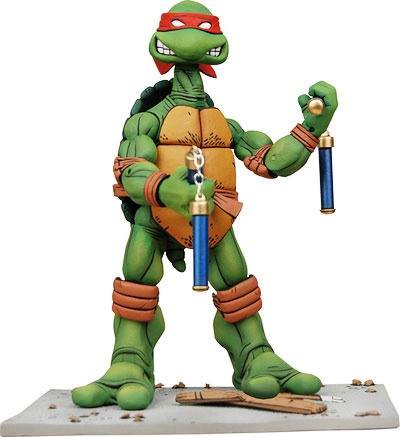
  P.S.  For the record, Michaelangelo was always my favourite.  And I still (secretly) intend on becoming awesome with the nunchucks.  Also, my love of Michaelangelo in particular may have been an early indicator that as an adult I would be drawn to "Play" in Martial Arts practice, which I'll definitely be talking about in later postings.


Sunday, October 9, 2011

Commitment, the Risk Spectrum and Looking Foolish

  Risk is a funny thing.

  In the context of skill development, risk is completely necessary to progress and yet we tend to avoid it like the plague.  Whether we're protecting our egos, our illusions of proficiency, or our bodies, we tend not to stray in directions that lead to unfamiliar outcomes.  In a lot of situations this is probably a good idea, but in day to day training/skill development, it can stunt our progress severely.
 
  To help my training and my teaching I use a scale I call the "Risk Spectrum".  Picture a line with zero at one end, and ten at the other.  The zero represents "No risk", 5 would be "Moderate risk", and 10 would be "Reckless".  Typically in the interests of our ego and self preservation, we spar and practice around 0-4 or 5.  We play it safe.  We follow paths we recognize,  use moves we're good at and lean toward techniques that we know will "work".  Unfortunately, this leaves a whole other range of movements, concepts and technique unexplored, untouched.

  0-5 represents our comfort zone.  Maybe if we're being bold we dip into a 6 one day while practicing but as soon as we feel the fluffy edges of our comfort zone getting too far from us, we retreat back into our safe range.   We can't properly learn and ingrain a technique unless we fully engage our bodies. However, often when we're trying a technique for the first time we "hold back", restraining ourselves, trying to do it perfectly, trying not to fail.  We've just watched an instructor demonstrate it and as soon as we start to move we can feel the disparity between what we've seen and what our bodies are doing.  So we proceed cautiously, measuring our movements, taking care not to tip over, or overextend, or God forbid, look foolish.

  Well here's a little secret that I try to remember:

If you want to continue on the path of mastery,
you have to allow yourself to look foolish, often.

  Almost nobody looks cool when they're doing something for the first time. You have to stumble and flop and fall over before you can even start to not look like an idiot.  You have to suck at "Mary had a little lamb" before you can enthrall listeners with the "Raindrop prelude". Usain Bolt had to plop down on his butt over and over learning to walk on wobbly legs before he could set world records while dancing. You have to be a spazzy white belt before you can be a smooth, calm black belt.

  How do we get there?  By giving ourselves permission to screw up.  You have to allow for this foolish, awkward, sometimes embarrassing clumsiness, every day.  If you reach a point where you feel like you've "arrived", and passed your "learner" stage, then that is the point where you stop learning.  The desire to progress must be paired with the willingness to be a perpetual student, and to be a student, you have to acknowledge your non-expert status.  

  Now for your viewing pleasure, here are a couple videos which have inspired me in the direction of embracing risk.  First up is Fernando "Terere" Augusto.  The portion of sparring starting at 6:00 blew me away.  The amount of pressure Terere is putting on his training partner by leaning in to the guard is unreal.  He completely trusts his balance and movement, and all his partner can do is try not to get bowled over and keep some distance.  If he lifts his feet at all he'll be falling backward and Terere will be attacking his back.  Now the tough part comes when you try to learn this style of passing.  It's not any one technique or "move" that you are trying to apply but rather a concept of applying pressure through "balancing" on your opponent/partner, and maintaining your connection.  So to build this into your body, you have to try to balance on your partner, which when you first attempt it, will likely result in your getting swept, triangled, and sometimes just falling over.  Without that full commitment to risk, you'll never figure out how to apply this kind of pressure in a way that benefits you, which is too bad, because it's quite effective once you get the hang of it.


  This next clip is a great example as well.  Gunnar Nelson, who is one of my absolute favourite grapplers to watch, and Michael Russell who has a pretty crazy guard game.  Gunnar is always coming forward, applying pressure, doing a balancing act on Russell who is inverting, spinning, working to off-balance and attack, and generally acting like a bar of soap under the pressure Gunnar is creating.  And in the midst of this dangerous guard game, Gunnar never stops coming forward, confident in his posture, balance and timing.  And when the opportunity presents itself, his body has already taken it.  This kind of game didn't appear out of a vacuum.  I'm guessing it took a lot of drilling and rolling, and a lot of risk. 


  So if you're going to try something, try the hell out of it.    Next time you want to introduce a new technique into your game, or flesh out your understanding of a concept, try it constantly.  Whether it's working or not, try it.  Whether it feels right or not, try it.  Just try it, try it, try it.  Tap like crazy, get swept, get passed, get crushed.  It's worth it.  Oh, and one more thing, enjoy yourself.  Once the pressure is off to win every roll while looking strong, confident and slick, BJJ (or any skill really) gets a lot more fun.  And isn't that why we're doing this in the first place?

Thursday, September 29, 2011

The Pathway and The Playground

  I'm really interested in how different people both approach training, and express that training.    As long as you just keep showing up, eventually your Jiu Jitsu will not only get better, more efficient, more effective and more fun, but it will also begin to better express your personality.

  I love seeing this transformation happen.  Yes, it's great to see the techniques start to work, and to see someone's rolling start to click for them but what really intrigues me is how each individual person's Jiu Jitsu reflects their personality.

  Mostly I see this personality start to really come out around purple belt, but there are definitely hints about what it's going to look like much earlier.  I started looking at my own Jiu Jitsu and that of my students and training partners in terms of two distinct paradigms: The Pathway and The Playground.

  Initially, a player will be drawn to one of these two sides.  This will be evidenced by the qualities they display in their expression, both in learning technique, and attempting to execute it. What I'm referring to here is their natural tendencies, not their competition gameplan. (Obviously in a competition, a player will most likely choose a strategy that will allow them to play to their strengths and avoid their weaknesses.) As the player gains experience, they will move  toward a more balanced approach, drawing qualities from both sides.

  On one side, we have The Pathway, which is direct, clear, fundamental, safe, simple, and strong.  On the other side we have The Playground, which can be described as indirect, spontaneous, improvisational, creative, complex and flowing.

   A Pathway player wants to impose their game, moving in a straight line.  I like to think of a Pathway player as being like a fridge passing the guard; they're moving forward and you can either get out of the way or get crushed.  Clear paths, minimal technique accumulation.  As beginners, these players tend to err on the side of caution, which can limit their exposure to new positions.  Some examples of more direct players would be Roger Gracie, Fabio Gurgel, Xande Ribeiro and Bernardo Faria.

  Someone on the Playground side is more interested in the movement, often sacrificing good position in favour of exploring new possibilities and quite often, they make it work.  At first, they may find it difficult to make anything work consistently, but eventually they come up with some really fun and unconventional positions and ideas.  These guys improvise really well, and drag their opponents out into the chaos because they know they can find their way back, whereas their opponent may get lost.  As beginners, they tend to get distracted when learning new technique; every option opens up 10 new possibilities.  Examples of less direct players are Eduardo Telles, Roleta,  Jeff Glover and Terere.

   As a player evolves and advances in skill, they may begin to move toward balance.  A balanced player draws on the qualities from both sides; fluid, complex improvisational abilites but also clear, well-defined paths.  Strong and heavy but also quick and light.   Their path is determined by what is needed in the moment.  This is what I strive for in my Jiu Jitsu.

    In the book Aikido and the Dynamic Sphere, which I'll likely refer to again in future posts, it says, "the attack itself contains the very elements which an Aikido defensive strategy will utilize physically, functionally and of course psychologically in neutralizing that attempted aggression".   This demands that a player not be single minded, or close minded, or too committed to one technique in the moment but instead be always listening, always receptive and self aware, and only doing exactly what is determined by the demands of the moment.   Of course, this type of flow is mostly impossible without a solid foundation of fundamentals, which must be ingrained into your body and mind through drilling and repetition.

  In my opinion, both approaches, The Pathway and The Playground, are vital to having a complete Jiu Jitsu game.

  In an art that walks the line between baffling complexity and utter simplicity, these two paradigms help me to express who I am, through my Jiu Jitsu.